✨Evolution of NIAZIT Open Web Steel Joists (OWSJ) ✨
Preface
In structural engineering literature, the term Open Web Steel Joist (OWSJ) in Europe, North America, and many other regions refers to steel joists whose web is completely free of concrete, meaning no concrete is placed within the web zone. The structural behavior of such joists is generally classified into two categories:
Non-Composite Action, where the joist alone resists dead and live loads.
Composite Action, where the joist works integrally with a concrete slab.
In contrast, in Iran, the term “open web joist” has been incorrectly used for joists whose web is filled with concrete, resulting in a T-shaped reinforced concrete section. From an engineering standpoint, these joists are considered closed-web systems. This conceptual misunderstanding has led to frequent confusion between NIAZIT steel joists and conventional Iranian steel joists with concrete-filled webs, despite their fundamentally different structural behavior, design philosophy, and code background.
Historical Development of Open Web Steel Joists in Europe and North America
In European and American structural systems, open web steel joists have long been recognized as primary load-carrying members in floors and roofs. These joists are typically designed without concrete in the web and may function either independently or compositely with a concrete slab, depending on the floor system.
Types of Open Web Steel Joists
1. Non-Composite Open Web Steel Joists
These joists are designed as steel truss systems and are capable of carrying dead and live loads without any contribution from concrete. They are commonly used as both primary and secondary structural members.
Typical examples include:
K-Series
LH-Series
DLH-Series
Their design and verification are governed by SJI Standard 100-2020.
2. Composite Open Web Steel Joists
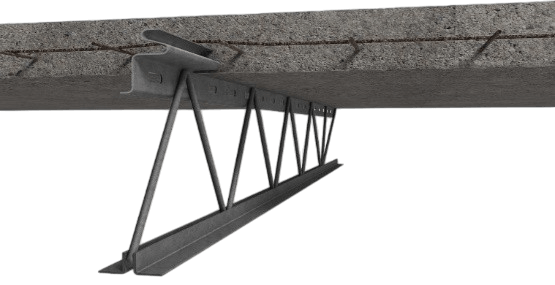
Composite joists are a subset of OWSJ systems in which the top chord participates in composite action with the concrete slab through:
shear studs, or
direct embedment of the top chord within the slab.
This system provides increased floor stiffness, reduced structural weight, and higher load-bearing capacity compared to non-composite joists.
A well-known example is the CJ-Series, designed in accordance with SJI Standard 200-2015.
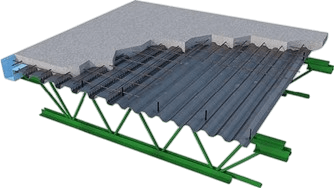
In most metal deck and steel deck floor systems in Europe and North America, open web steel joists are widely used in place of secondary steel beams, resulting in optimized steel consumption and faster construction.
Development of Steel Joists in Iran
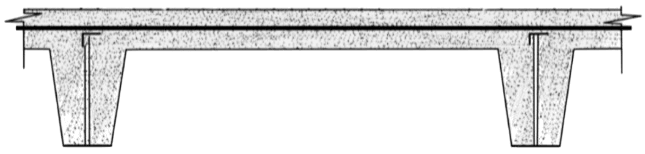
1. Steel Joists with Concrete-Filled Webs (Commonly Known as Cormit)
Steel joists were first introduced to the Iranian engineering community in 1977 and entered the construction market in 1979. By 1983, this system became widely known as the “open web joist” and later under the commercial name Cormit Joist.
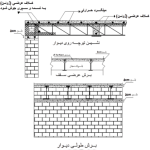
In this system, the web is filled with concrete, forming a T-shaped reinforced concrete section similar to traditional joist–block floors. From a structural perspective, this system is classified as a closed-web joist, despite its misleading terminology.
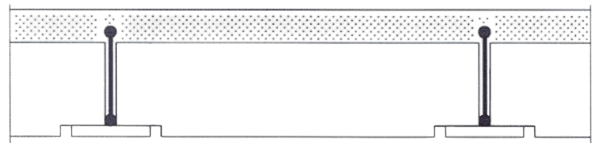
2. Truss Joists without Concrete in the Web
In 2001, a truss-type steel joist with a fully concrete-free web was introduced in Iran, closely resembling European OWSJ systems. In this design, the top chord consisted of reinforcing bars, and the joist behavior aligned with true open web steel joists.
This system was registered under Patent No. 27734, and its load tests were officially approved by the Building and Housing Research Center of Iran.
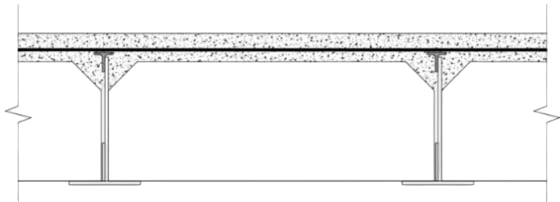
3. Multi-System Structural Joist (NIAZIT)
In 2019, with the aim of optimizing previous generations of concrete-free joists, a new system titled “Structural Joist Applicable to Various Floor Systems” was introduced under Patent No. 98813 and commercialized as NIAZIT Joist.
The optimized design of the top chord and the modular arrangement of truss components enable:
compatibility with various floor systems,
application in both steel and reinforced concrete frames, and
improved structural and economic performance compared to domestic and international counterparts.
From a design philosophy and performance standpoint, the NIAZIT joist represents one of the most optimized open web steel joist systems developed in Iran.
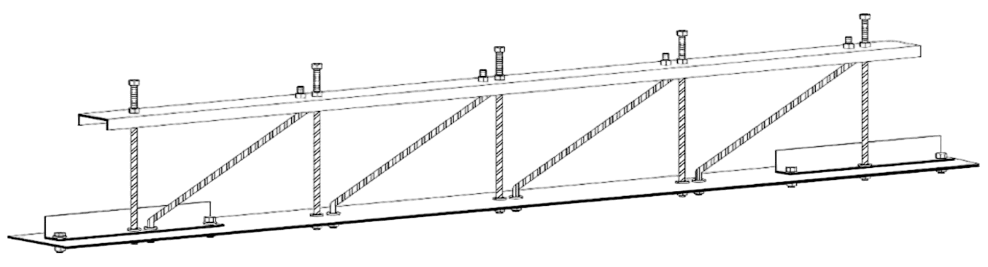
4. Composite Joist with Integrated Shear Studs and Bolted Connections (CAMO)
In 2021, an advanced generation of NIAZIT joists was introduced under the title Composite Joist with Integrated Shear Studs and Weld-Free Connections, registered as Patent No. 105559 and marketed as CAMO Joist.
This system was internationally registered in August 2022 under WIPO No. WO2022172065.
Key distinguishing features include:
complete elimination of welding in primary connections,
use of industrial bolted connections,
integrated shear studs within the joist web, and
fully controllable and code-compliant composite behavior.
These characteristics place the CAMO joist among the most advanced composite steel joist systems, even when compared with conventional European and North American OWSJ solutions.